Product Examiner
SOC 51-9061.00 · ESCO 7543 · OSCA 839231
Role snapshot
Overview
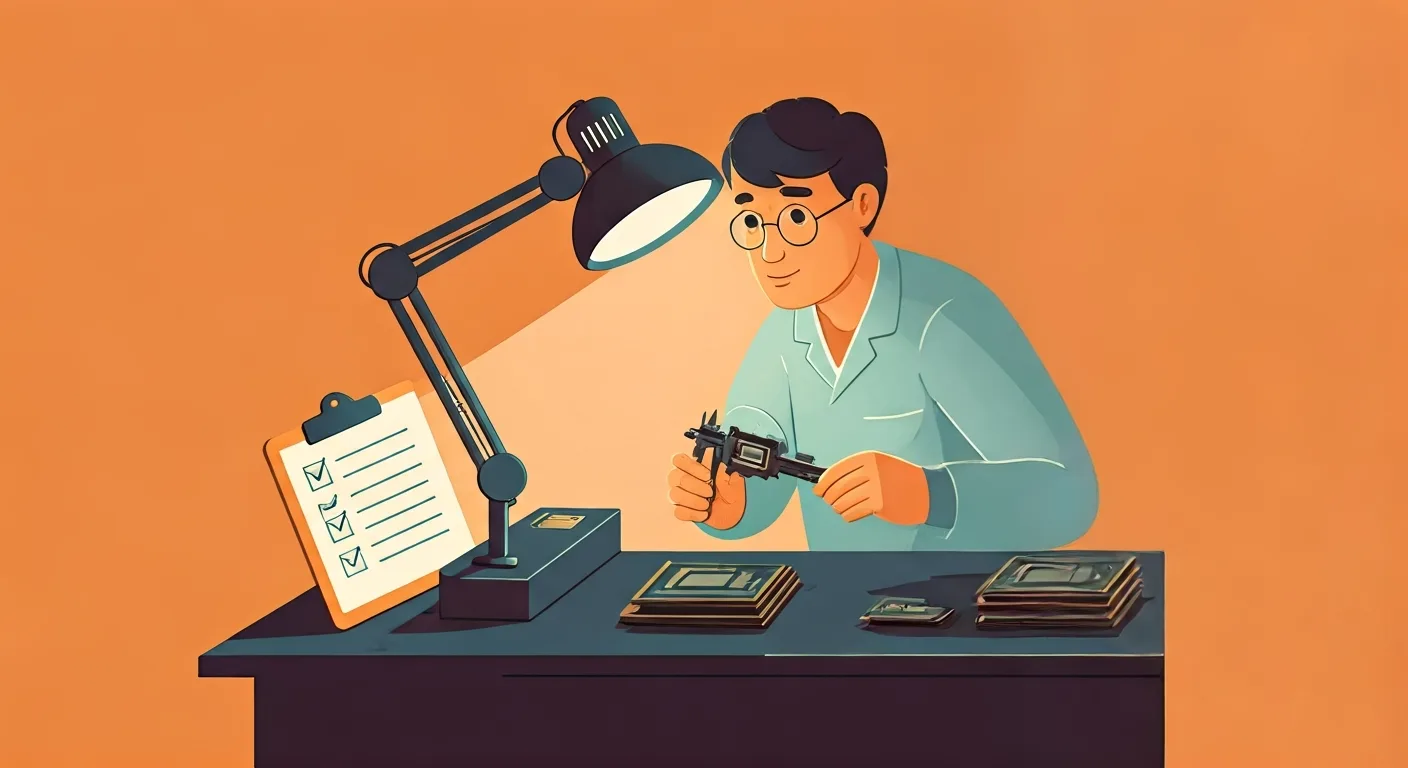
A Product Examiner meticulously inspects manufactured goods at various stages of production to identify defects, damage, or deviations from established quality specifications. This role involves detailed visual inspections, using measurement tools, documenting findings, and ensuring that only products meeting quality standards proceed through the production process or are released to customers. They are critical in maintaining product quality and preventing substandard items from reaching the market.
Ensures the quality and integrity of manufactured goods, reducing waste, preventing customer complaints, and upholding the company's reputation for reliable products.
On the job
- Perform visual inspections of products for surface imperfections, damage, and assembly errors.
- Use precision measuring instruments such as calipers, micrometers, and gauges to verify product dimensions.
- Compare products against blueprints, specifications, and quality standards.
- Document inspection results, including details of defects, quantities, and rejection reasons.
- Isolate and tag non-conforming products, initiating procedures for rework or disposal.
Tools & technology
Average salary
Job outlook
StableDemand is steady. This is an established role with consistent hiring across sectors.
Education & training
High school diploma or GED is typically required, with some roles preferring vocational training or a certificate in quality control or a related manufacturing field.
AI impact outlook
Note — this is our current view. AI is moving fast, so we revisit these ratings.
Show how this was assessed Hide the detail
Note — this is our current view. AI is moving fast, so we revisit these ratings.
Show how this was assessed Hide the detailWhy this role received this rating
Core task exposure
high
How much of the role’s important work could AI perform?
Visual inspection, dimensional measurement, comparison to specifications, and documentation are highly susceptible to AI automation.
End-to-end automation
moderate
Can AI complete the work without substantial human involvement?
While AI can perform inspections, the physical handling of non-conforming products and critical final decision-making keep humans in the loop.
Adoption pressure
high
How likely are employers to introduce AI into this work?
Employers are highly likely to adopt AI for quality control due to clear ROI in consistency, speed, and defect detection.
Human dependence
moderate
How much does success depend on human judgement, relationships and accountability?
Success in this role hinges on nuanced judgment in defect assessment, accountability for product release, and collaborating on complex issues.
Protective — a higher rating lowers the overall score.
Role adaptability
strong
How easily can the role evolve as AI takes on more tasks?
The role can readily evolve towards managing automated inspection systems, focusing on process improvement, and resolving complex quality issues.
Shown for context — not part of the score.
What AI may take on
These are the parts of the role most likely to be automated or significantly accelerated.
- Performing detailed visual inspections for surface imperfections and assembly errors
- Using precision measuring instruments to verify product dimensions against specifications
- Comparing products against blueprints and quality standards for deviations
- Documenting inspection results, including defect details and rejection reasons
Where people remain essential
These parts continue to depend heavily on human judgement, relationships and accountability.
- Making final, high-stakes decisions on product release or recall where human accountability is paramount
- Interpreting ambiguous or novel defects that AI models struggle to classify
- Troubleshooting the root causes of recurring quality issues in collaboration with production teams
- Managing the physical isolation and tagging of non-conforming units, especially for varied items
- Developing and refining quality specifications and inspection protocols
How the role may evolve
From routine checks to complex anomaly resolution.
The shift will be away from repetitive visual and dimensional checks, moving towards a focus on interpreting edge cases, driving process improvements, and ensuring ultimate product accountability.
Strengthen your future fit
- Develop expertise in operating and monitoring AI-powered inspection systems
- Enhance critical thinking for complex problem-solving and root cause analysis
- Strengthen collaboration and communication skills with engineering and production teams
- Acquire knowledge of statistical process control and quality management methodologies
- Assessment horizon
- 3–7 years
- Confidence
- High
- Last reviewed
- August 2026
- Methodology
- v1.0
This assessment reflects current AI capabilities and expected adoption patterns. Actual impacts will vary by industry, employer and the way each role is performed.
Career pathways
WHERE YOU COULD GO
CURRENT ROLE
Product Examiner
Manufacturing & Production
ADJACENT MOVES
STARTING POINTS
Who thrives here
Interest profile
realistic · RCI
Individuals who enjoy hands-on, practical tasks, systematic procedures, and analytical problem-solving are well-suited for this role.
Personality characteristics
Detail-oriented
Meticulously checks products for even minor flaws and ensures adherence to precise specifications.
Methodical
Prefers structured tasks and follows established procedures to ensure consistent quality control.
Observant
Possesses a keen eye for discrepancies and can quickly identify non-conforming items.
Reliable
Consistently performs tasks with accuracy and takes responsibility for product quality.
Composed
Maintains a steady focus and calm demeanor, even when under pressure to meet production targets.
Best for
- Individuals who thrive on precision, order, and ensuring things are 'just right'.
- People who enjoy detailed, hands-on work in a structured manufacturing environment.
Watch out for
- Repetitive tasks may not suit those seeking constant novelty or creative expression.
- The emphasis on strict adherence to rules might feel restrictive for highly autonomous individuals.
A week in the life
A representative working week for a Product Examiner — where the deep work, meetings, and admin actually land.
Real people. Real results.
Thousands of people
can't be wrong.




Frequently asked questions about Product Examiner roles
What does a Product Examiner do?
A Product Examiner a Product Examiner meticulously inspects manufactured goods at various stages of production to identify defects, damage, or deviations from established quality specifications. This role involves detailed visual inspections, using measurement tools, documenting findings, and ensuring that only products meeting quality standards proceed through the production process or are released to customers. They are critical in maintaining product quality and preventing substandard items from reaching the market. Ensures the quality and integrity of manufactured goods, reducing waste, preventing customer complaints, and upholding the company's reputation for reliable products.
How much does a Product Examiner earn?
A Product Examiner earns a median of $45,000 per year in the US, typically ranging from $35,000 to $58,000.
What qualifications do you need to become a Product Examiner?
To become a Product Examiner, high school diploma or GED is typically required, with some roles preferring vocational training or a certificate in quality control or a related manufacturing field.
What personality suits a Product Examiner?
Product Examiner roles tend to suit people who are highly conscientious — precise, organised and strong on follow-through (Conscientiousness 85/100) and steady under pressure — deadlines and setbacks do not rattle them easily (Emotional Stability 72/100). The traits that matter most in the role are Detail-oriented, Methodical, Observant and Reliable. Meticulously checks products for even minor flaws and ensures adherence to precise specifications. On interests, Product Examiner maps to a RCI Holland Code profile — individuals who enjoy hands-on, practical tasks, systematic procedures, and analytical problem-solving are well-suited for this role.
Who does a Product Examiner role suit?
A Product Examiner role is usually a strong fit for these reasons. Strong Realistic (R) and Conventional (C) alignment, rewarding precision and adherence to standards. A significant portion of the week involves focused, independent inspection and analysis. The role offers a clear sense of contributing to product integrity and preventing errors.
What are the downsides of being a Product Examiner?
Product Examiner roles come with trade-offs worth weighing up. Repetitive tasks may not suit those seeking constant novelty or creative expression. The emphasis on strict adherence to rules might feel restrictive for highly autonomous individuals.
What is the work environment like for a Product Examiner?
Work as a Product Examiner is mostly manufacturing-floor-based with onsite arrangements common, highly structured, with set processes and deadlines, a moderate pace and medium exposure to clients or stakeholders. Around 60% of the week is focused deep work.
What skills do you need to be a Product Examiner?
Core skills for a Product Examiner include Quality inspection, Attention to detail, Technical documentation, Precision measurement and Problem identification.
How do you become a Product Examiner?
Common entry routes into Product Examiner roles include Production Assembler, Manufacturing Operator and Entry Level Inspector.
What career progression is there for a Product Examiner?
From a Product Examiner role, common next steps include Quality Control Lead, Quality Assurance Technician and Manufacturing Supervisor; lateral moves include Process Improvement Specialist.
What is the job outlook for Product Examiner roles?
The outlook for Product Examiner roles is currently rated stable. Demand is steady. This is an established role with consistent hiring across sectors.
Will AI replace Product Examiner roles?
Traitstack rates automation risk for Product Examiner roles at 64 out of 100, which is strong. AI will streamline visual and dimensional inspections, allowing examiners to focus on complex anomaly detection and high-stakes product release decisions. AI is most likely to take on performing detailed visual inspections for surface imperfections and assembly errors, using precision measuring instruments to verify product dimensions against specifications and comparing products against blueprints and quality standards for deviations. Making final, high-stakes decisions on product release or recall where human accountability is paramount, interpreting ambiguous or novel defects that ai models struggle to classify and troubleshooting the root causes of recurring quality issues in collaboration with production teams stay with people. From routine checks to complex anomaly resolution. That score measures how much of the work could change, not the likelihood the job disappears. It is Traitstack's current view, revisited as AI capability moves.