Welder (First Class)
SOC 51-4121.00 · ESCO 7212 · OSCA 331133
Role snapshot
Overview
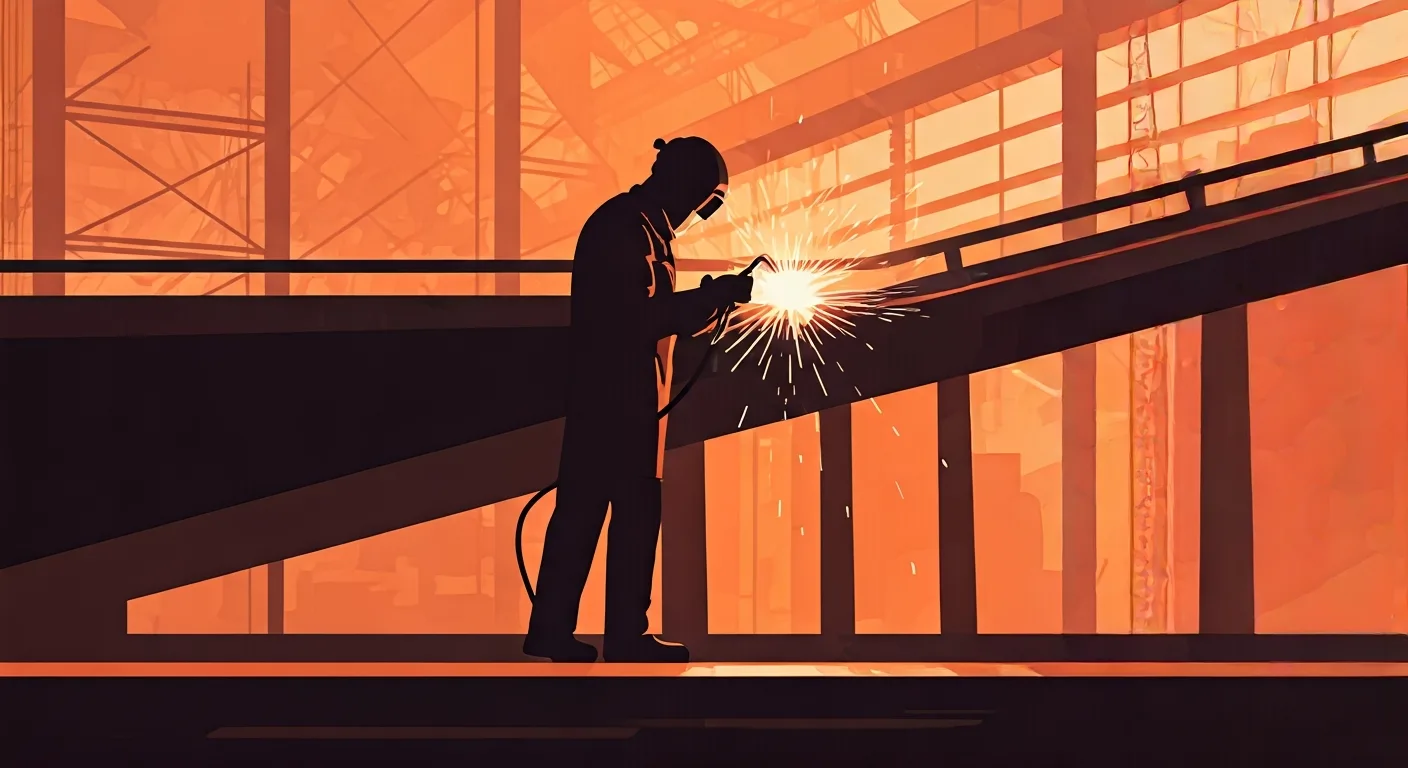
Joins metal components using various welding processes such as arc, MIG, TIG, or oxy-acetylene on structural, mechanical, or fabrication projects. A first-class welder is highly skilled, capable of reading and interpreting complex engineering drawings, and ensures all welds meet stringent quality and safety standards for structural integrity and performance.
Ensures the structural integrity and functionality of metal products and structures, from buildings and bridges to machinery and vehicles. Critical for safety, durability, and the quality of manufactured goods.
On the job
- Interpret complex blueprints, engineering drawings, and specifications to plan welding operations
- Select appropriate welding equipment, consumables, and techniques based on material type and project requirements
- Perform various welding processes (e.g., MIG, TIG, SMAW) to join metal parts accurately and efficiently
- Inspect finished welds for quality, defects, and adherence to codes and standards using precision measuring instruments
- Maintain welding equipment, ensuring proper calibration and safe operation
Tools & technology
Average salary
Job outlook
StableDemand is steady. This is an established role with consistent hiring across sectors.
Education & training
Typically requires a welding certificate or diploma from a technical school, or completion of a formal apprenticeship program.
AI impact outlook
Note — this is our current view. AI is moving fast, so we revisit these ratings.
Show how this was assessed Hide the detail
Note — this is our current view. AI is moving fast, so we revisit these ratings.
Show how this was assessed Hide the detailWhy this role received this rating
Core task exposure
low
How much of the role’s important work could AI perform?
AI can support interpreting complex blueprints and initial weld parameter suggestions, but the dynamic, manual execution of structurally critical, diverse welds has minimal direct AI exposure.
End-to-end automation
low
Can AI complete the work without substantial human involvement?
The bespoke nature of first-class welding, involving varied materials and safety-critical applications, makes end-to-end automation without human oversight impractical and risky.
Adoption pressure
low
How likely are employers to introduce AI into this work?
While AI-enhanced tools for planning and quality assurance may see some adoption, the high-stakes, custom nature of this work limits the widespread introduction of full automation.
Human dependence
strong
How much does success depend on human judgement, relationships and accountability?
The role's success is profoundly dependent on the welder's mastery of technique, real-time judgment during welding, adherence to stringent codes, and ultimate accountability for structural integrity.
Protective — a higher rating lowers the overall score.
Role adaptability
strong
How easily can the role evolve as AI takes on more tasks?
The role adapts by incorporating advanced materials, digital inspection tools, and new welding processes, while maintaining its core focus on expert manual application and quality.
Shown for context — not part of the score.
What AI may take on
These are the parts of the role most likely to be automated or significantly accelerated.
- Interpreting complex engineering drawings and specifications.
- Suggesting optimal welding parameters for specific material combinations and conditions.
- Real-time monitoring of weld quality via computer vision systems.
- Predictive analysis of material stress and potential failure points in designs.
- Automated reporting on weld conformity to codes and standards.
Where people remain essential
These parts continue to depend heavily on human judgement, relationships and accountability.
- Performing diverse, non-standard welding processes with high precision and artistry.
- Making real-time, on-the-spot adjustments during the welding process based on material behavior.
- Critical inspection of finished welds for subtle defects not detectable by sensors.
- Ensuring compliance with stringent industry codes, safety standards, and regulatory requirements.
- Problem-solving unexpected material reactions or structural challenges during fabrication.
- Bearing professional accountability and liability for structural integrity.
How the role may evolve
Enhancing structural integrity through AI-informed welding and inspection.
First-class welders will leverage AI for planning and quality analysis, allowing them to focus on the advanced manual skills and critical judgment essential for structurally sound and compliant welds.
Strengthen your future fit
- Expertise in advanced welding techniques and specialized materials.
- Proficiency in digital blueprint interpretation and planning tools.
- Critical visual inspection and defect identification skills.
- Deep understanding of welding codes, standards, and safety protocols.
- Problem-solving for complex and unique structural challenges.
- Assessment horizon
- 3–7 years
- Confidence
- High
- Last reviewed
- August 2026
- Methodology
- v1.0
This assessment reflects current AI capabilities and expected adoption patterns. Actual impacts will vary by industry, employer and the way each role is performed.
Career pathways
WHERE YOU COULD GO
CURRENT ROLE
Welder (First Class)
Skilled Trades
ADJACENT MOVES
STARTING POINTS
Who thrives here
Interest profile
realistic · RCI
People who enjoy hands-on work, using tools and machinery to solve practical problems, and applying technical knowledge to create precise structures tend to thrive in this role.
Personality characteristics
Practical Thinker
Prefers to focus on tangible, real-world applications and proven methods rather than abstract theories.
Precise
Demonstrates meticulous attention to detail, ensuring welds meet exact specifications and quality standards.
Independent
Comfortable working autonomously on tasks, often in focused, hands-on environments.
Cooperative
Works effectively with team members and supervisors when collaboration is required for larger projects.
Steady
Maintains composure and focus in challenging or hazardous conditions, handling pressure calmly.
Best for
- Individuals who enjoy working with their hands and seeing tangible results of their efforts
- Those who thrive in structured environments with clear technical standards and procedures
- People who value precision, safety, and continuous skill development in a specialized trade
Watch out for
- The work environment can be physically demanding and often involves exposure to heat, fumes, and loud noises
- Requires continuous learning and certification to keep up with new technologies and safety standards
A week in the life
A representative working week for a Welder (First Class) — where the deep work, meetings, and admin actually land.
Real people. Real results.
Thousands of people
can't be wrong.

Frequently asked questions about Welder (First Class) roles
What does a Welder (First Class) do?
A Welder (First Class) joins metal components using various welding processes such as arc, MIG, TIG, or oxy-acetylene on structural, mechanical, or fabrication projects. A first-class welder is highly skilled, capable of reading and interpreting complex engineering drawings, and ensures all welds meet stringent quality and safety standards for structural integrity and performance. Ensures the structural integrity and functionality of metal products and structures, from buildings and bridges to machinery and vehicles. Critical for safety, durability, and the quality of manufactured goods.
How much does a Welder (First Class) earn?
A Welder (First Class) earns a median of $60,000 per year in the US, typically ranging from $45,000 to $80,000.
What qualifications do you need to become a Welder (First Class)?
To become a Welder (First Class), typically requires a welding certificate or diploma from a technical school, or completion of a formal apprenticeship program. AWS Certified Welder (American Welding Society) certification.
What personality suits a Welder (First Class)?
Welder (First Class) roles tend to suit people who are highly conscientious — precise, organised and strong on follow-through (Conscientiousness 80/100) and steady under pressure — deadlines and setbacks do not rattle them easily (Emotional Stability 72/100). The traits that matter most in the role are Practical Thinker, Precise, Independent and Cooperative. Prefers to focus on tangible, real-world applications and proven methods rather than abstract theories. On interests, Welder (First Class) maps to a RCI Holland Code profile — people who enjoy hands-on work, using tools and machinery to solve practical problems, and applying technical knowledge to create precise structures tend to thrive in this role.
Who does a Welder (First Class) role suit?
A Welder (First Class) role is usually a strong fit for these reasons. Strong Realistic (R) alignment: the role is highly hands-on, requiring skilled use of tools and machinery. High Conventional (C) affinity: demands precision, adherence to safety protocols, and interpretation of technical drawings. Investigative (I) interest: involves problem-solving and understanding the science behind welding processes and materials.
What are the downsides of being a Welder (First Class)?
Welder (First Class) roles come with trade-offs worth weighing up. The work environment can be physically demanding and often involves exposure to heat, fumes, and loud noises. Requires continuous learning and certification to keep up with new technologies and safety standards.
What is the work environment like for a Welder (First Class)?
Work as a Welder (First Class) is mostly mixed-based with onsite arrangements common, semi-structured — a mix of set processes and self-directed work, a moderate pace and low exposure to clients or stakeholders. Around 45% of the week is focused deep work.
What skills do you need to be a Welder (First Class)?
Core skills for a Welder (First Class) include Arc welding techniques, Blueprint reading, Metal fabrication, Quality control and inspection, Safety procedures and Equipment maintenance.
How do you become a Welder (First Class)?
Common entry routes into Welder (First Class) roles include Welder Apprentice, Junior Welder and Metal Fabricator.
What career progression is there for a Welder (First Class)?
From a Welder (First Class) role, common next steps include Lead Welder and Welding Supervisor; lateral moves include Welding Inspector and Fabrication Specialist.
What is the job outlook for Welder (First Class) roles?
The outlook for Welder (First Class) roles is currently rated stable. Demand is steady. This is an established role with consistent hiring across sectors.
Will AI replace Welder (First Class) roles?
Traitstack rates automation risk for Welder (First Class) roles at 22 out of 100, which is low. AI can assist with blueprint interpretation and quality assessment, but the dynamic, manual skill and high-stakes judgment required for certified structural welding remain fundamentally human. AI is most likely to take on interpreting complex engineering drawings and specifications., suggesting optimal welding parameters for specific material combinations and conditions. and real-time monitoring of weld quality via computer vision systems.. Performing diverse, non-standard welding processes with high precision and artistry., making real-time, on-the-spot adjustments during the welding process based on material behavior. and critical inspection of finished welds for subtle defects not detectable by sensors. stay with people. Enhancing structural integrity through AI-informed welding and inspection. That score measures how much of the work could change, not the likelihood the job disappears. It is Traitstack's current view, revisited as AI capability moves.