Gunsmith
SOC 49-9094.00 · ESCO 7222 · OSCA 332333
Role snapshot
Overview
Repairs, services, and modifies firearms by diagnosing mechanical faults, replacing worn parts, and adjusting triggers and sights. May also build custom rifles or shotguns and ensures all work complies with federal and state firearms legislation. This role requires precision craftsmanship, deep knowledge of firearm mechanics, and strict adherence to safety and regulatory standards.
Ensures the safe, reliable, and legal operation of firearms for sport, hunting, and personal defense. Provides custom solutions and preserves the functionality of valuable or historical weapons, contributing to responsible firearm ownership.
On the job
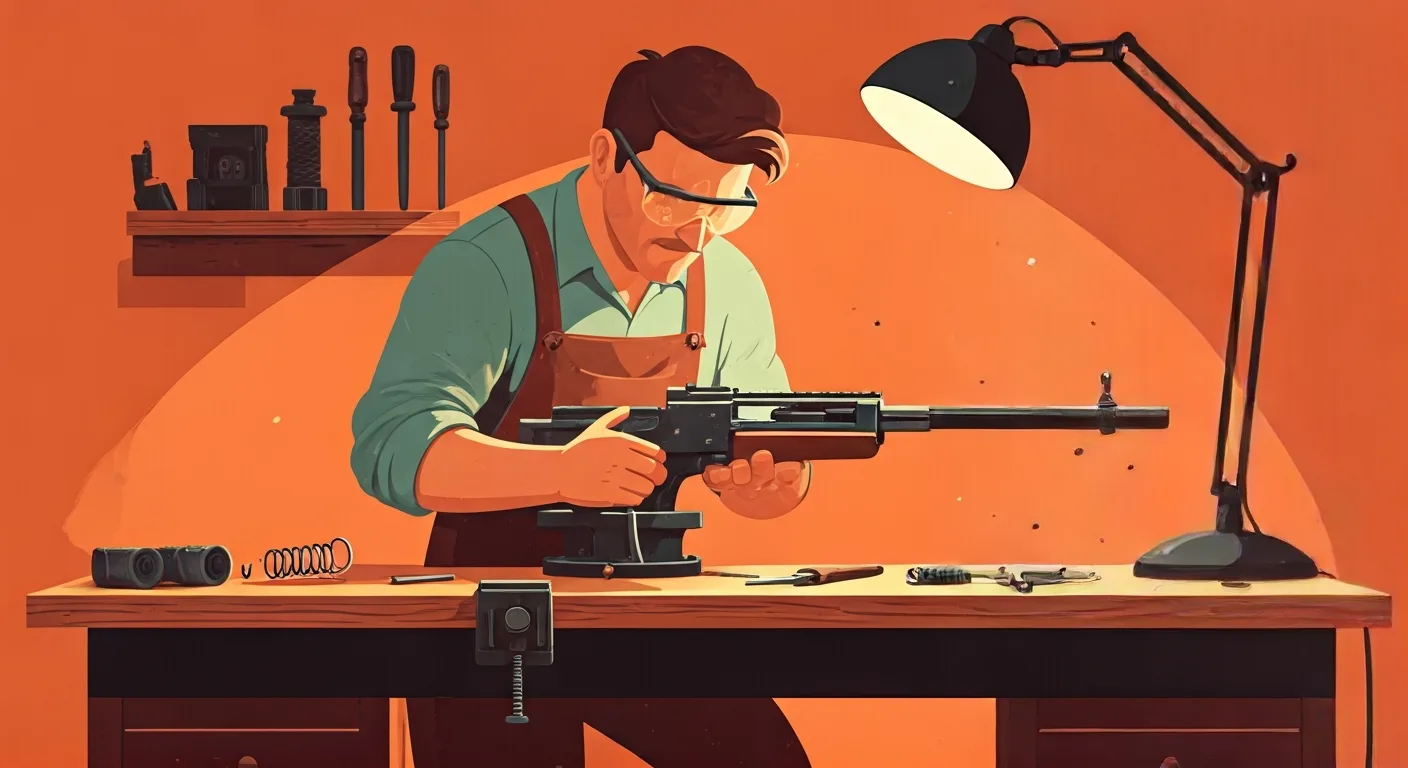
- Diagnose mechanical faults and wear in various types of firearms using specialized tools and techniques.
- Perform intricate repairs, replace worn or broken parts, and adjust firearm components such as triggers, sights, and stocks.
- Customise firearms to client specifications, which may involve machining new parts, refinishing surfaces, or modifying existing structures.
- Test-fire repaired or custom-built firearms to verify functionality, accuracy, and safety standards.
- Maintain meticulous records of all work performed, parts used, and firearm transactions, ensuring full compliance with federal, state, and local firearms regulations.
Tools & technology
Average salary
Job outlook
StableDemand is steady. This is an established role with consistent hiring across sectors.
Education & training
Completion of a specialized gunsmithing program, apprenticeship, or extensive on-the-job training. Some may hold certifications from professional organizations.
AI impact outlook
Note — this is our current view. AI is moving fast, so we revisit these ratings.
Show how this was assessed Hide the detail
Note — this is our current view. AI is moving fast, so we revisit these ratings.
Show how this was assessed Hide the detailWhy this role received this rating
Core task exposure
low
How much of the role’s important work could AI perform?
While AI could assist with fault diagnosis or generate machining paths, intricate custom work, subjective adjustments, and test-firing are profoundly human-dependent.
End-to-end automation
low
Can AI complete the work without substantial human involvement?
The high precision, legal accountability, and inherent danger of firearms make end-to-end automation impossible without human craftsmanship and judgment.
Adoption pressure
low
How likely are employers to introduce AI into this work?
The niche market, stringent regulations, high liability, and preference for craftsmanship limit automation adoption significantly.
Human dependence
strong
How much does success depend on human judgement, relationships and accountability?
Success relies almost entirely on human expertise in firearm mechanics, precision craftsmanship, adherence to safety, and legal accountability.
Protective — a higher rating lowers the overall score.
Role adaptability
moderate
How easily can the role evolve as AI takes on more tasks?
The role can adapt by specializing in antique firearm restoration, custom rifle building, or moving into firearm manufacturing R&D or forensic analysis.
Shown for context — not part of the score.
What AI may take on
These are the parts of the role most likely to be automated or significantly accelerated.
- Assisted diagnosis of common mechanical faults based on component scans
- Generating optimal machining paths for standardized part fabrication
- Automated checking of firearm serial numbers against regulatory databases
- Digital archiving of repair and customization records
Where people remain essential
These parts continue to depend heavily on human judgement, relationships and accountability.
- Intricate manual repairs and replacement of worn or broken parts
- Customizing firearms to client specifications, including aesthetic and ergonomic modifications
- Precision adjustment of triggers, sights, and stocks for optimal performance
- Test-firing firearms to verify functionality, accuracy, and safety standards
- Ensuring strict compliance with federal, state, and local firearms regulations
- Applying specialized finishes and performing firearm restoration
How the role may evolve
Shifting from routine repair to bespoke firearm craftsmanship.
Gunsmiths will increasingly leverage AI for diagnostic support and administrative tasks, freeing them to concentrate on complex, custom fabrication, intricate repairs, and ensuring rigorous compliance.
Strengthen your future fit
- Mastering advanced machining techniques and CAD/CAM software
- Deepening knowledge of firearm ballistics and internal mechanics
- Acquiring expertise in specialized finishes and restoration methods
- Staying current with evolving firearms legislation and safety standards
- Developing strong client consultation and custom design skills
- Assessment horizon
- 3–7 years
- Confidence
- High
- Last reviewed
- August 2026
- Methodology
- v1.0
This assessment reflects current AI capabilities and expected adoption patterns. Actual impacts will vary by industry, employer and the way each role is performed.
Career pathways
WHERE YOU COULD GO
CURRENT ROLE
Gunsmith
Skilled Trades
ADJACENT MOVES
STARTING POINTS
Who thrives here
Interest profile
realistic · RCI
Individuals who thrive on hands-on technical work, problem-solving through mechanical analysis, and meticulous attention to detail in a structured environment often find satisfaction as a Gunsmith.
Personality characteristics
Detail-oriented
Possesses a meticulous approach to working with small, precise components and ensuring perfect fit and finish.
Analytical
Enjoys diagnosing complex mechanical issues and devising effective repair or customization solutions.
Patient
Capable of spending extended periods on intricate tasks, requiring steady hands and focused concentration.
Independent
Prefers working autonomously on projects from start to finish, managing tasks with minimal supervision.
Practical
Driven by tangible results and the satisfaction of expertly repairing or creating functional mechanical devices.
Best for
- Individuals who enjoy intricate mechanical work, problem-solving with their hands, and restoring complex devices.
- Those who value precision, craftsmanship, and adherence to high standards in a technical environment.
- People comfortable working independently and managing their own projects from diagnosis to completion.
Watch out for
- The work can be solitary, with limited team interaction compared to other roles.
- Strict regulatory compliance and safety protocols are paramount and require constant vigilance and accurate record-keeping.
A week in the life
A representative working week for a Gunsmith — where the deep work, meetings, and admin actually land.
Real people. Real results.
Thousands of people
can't be wrong.


Frequently asked questions about Gunsmith roles
What does a Gunsmith do?
A Gunsmith repairs, services, and modifies firearms by diagnosing mechanical faults, replacing worn parts, and adjusting triggers and sights. May also build custom rifles or shotguns and ensures all work complies with federal and state firearms legislation. This role requires precision craftsmanship, deep knowledge of firearm mechanics, and strict adherence to safety and regulatory standards. Ensures the safe, reliable, and legal operation of firearms for sport, hunting, and personal defense. Provides custom solutions and preserves the functionality of valuable or historical weapons, contributing to responsible firearm ownership.
How much does a Gunsmith earn?
A Gunsmith earns a median of $55,000 per year in the US, typically ranging from $35,000 to $80,000.
What qualifications do you need to become a Gunsmith?
To become a Gunsmith, completion of a specialized gunsmithing program, apprenticeship, or extensive on-the-job training. Some may hold certifications from professional organizations. Federal Firearms License (FFL).
What personality suits a Gunsmith?
Gunsmith roles tend to suit people who are highly conscientious — precise, organised and strong on follow-through (Conscientiousness 82/100) and steady under pressure — deadlines and setbacks do not rattle them easily (Emotional Stability 75/100). The traits that matter most in the role are Detail-oriented, Analytical, Patient and Independent. Possesses a meticulous approach to working with small, precise components and ensuring perfect fit and finish. On interests, Gunsmith maps to a RCI Holland Code profile — individuals who thrive on hands-on technical work, problem-solving through mechanical analysis, and meticulous attention to detail in a structured environment often find satisfaction as a Gunsmith.
Who does a Gunsmith role suit?
A Gunsmith role is usually a strong fit for these reasons. Strong Realistic (R) and Conventional (C) alignment: the role demands practical, hands-on skills and adherence to established procedures. Significant time spent on deep, focused work, appealing to those who prefer independent problem-solving and craftsmanship. Requires meticulous attention to detail and a high degree of precision in mechanical work and regulatory compliance.
What are the downsides of being a Gunsmith?
Gunsmith roles come with trade-offs worth weighing up. The work can be solitary, with limited team interaction compared to other roles. Strict regulatory compliance and safety protocols are paramount and require constant vigilance and accurate record-keeping.
What is the work environment like for a Gunsmith?
Work as a Gunsmith is mostly workshop-based with onsite arrangements common, semi-structured — a mix of set processes and self-directed work, a moderate pace and medium exposure to clients or stakeholders. Around 53% of the week is focused deep work.
What skills do you need to be a Gunsmith?
Core skills for a Gunsmith include Firearms repair and maintenance, Precision machining and fabrication, Metalworking and finishing techniques, Diagnostic troubleshooting of mechanical systems and Regulatory compliance (firearms legislation).
How do you become a Gunsmith?
Common entry routes into Gunsmith roles include Gunsmithing Apprentice, Firearms Mechanic and Machinist Apprentice.
What career progression is there for a Gunsmith?
From a Gunsmith role, common next steps include Master Gunsmith and Firearms Design Engineer; lateral moves include Machinist and Tool and Die Maker.
What is the job outlook for Gunsmith roles?
The outlook for Gunsmith roles is currently rated stable. Demand is steady. This is an established role with consistent hiring across sectors.
Will AI replace Gunsmith roles?
Traitstack rates automation risk for Gunsmith roles at 14 out of 100, which is low. Deep human craftsmanship and legal accountability are paramount in gunsmithing, with AI unlikely to handle precision repairs or custom modifications. AI is most likely to take on assisted diagnosis of common mechanical faults based on component scans, generating optimal machining paths for standardized part fabrication and automated checking of firearm serial numbers against regulatory databases. Intricate manual repairs and replacement of worn or broken parts, customizing firearms to client specifications, including aesthetic and ergonomic modifications and precision adjustment of triggers, sights, and stocks for optimal performance stay with people. Shifting from routine repair to bespoke firearm craftsmanship. That score measures how much of the work could change, not the likelihood the job disappears. It is Traitstack's current view, revisited as AI capability moves.