Pressure Welder
SOC 51-4121.00 · ESCO 7212 · OSCA 331132
Role snapshot
Overview
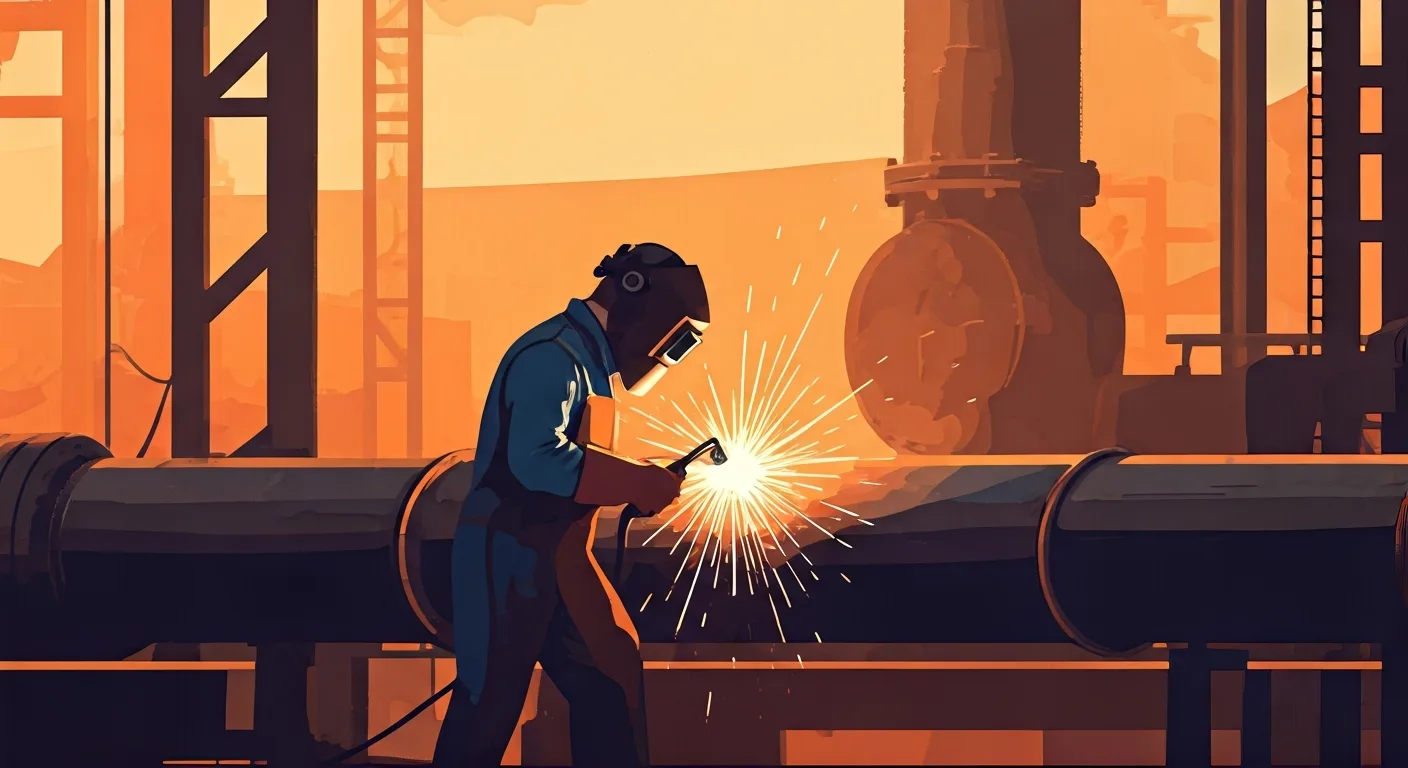
Welds pipes, boilers, and pressure vessels to strict standards using specialised techniques that ensure joints can withstand high temperatures and pressures. Interprets technical drawings and passes coded weld tests. Specializes in materials and methods for critical, high-stress applications in industries such as energy, manufacturing, and construction.
Ensures the safe and reliable operation of critical infrastructure by creating welds that can withstand extreme conditions, preventing catastrophic failures and protecting public safety and assets.
On the job
- Read and interpret blueprints, welding procedure specifications (WPS), and engineering drawings to plan welding operations.
- Prepare materials by cleaning, grinding, and accurately fitting components for welding, ensuring precise alignment.
- Perform various welding processes, such as TIG, MIG, and Stick, on high-pressure systems, often in challenging positions.
- Conduct visual inspections of welds and prepare welds for non-destructive testing (NDT) to verify integrity and quality.
- Maintain welding equipment, troubleshoot issues, and ensure strict compliance with safety protocols and industry codes.
Tools & technology
Average salary
Job outlook
StableDemand is steady. This is an established role with consistent hiring across sectors.
Education & training
Completion of an accredited welding apprenticeship program or a post-secondary certificate in pressure welding is typically required.
AI impact outlook
Note — this is our current view. AI is moving fast, so we revisit these ratings.
Show how this was assessed Hide the detail
Note — this is our current view. AI is moving fast, so we revisit these ratings.
Show how this was assessed Hide the detailWhy this role received this rating
Core task exposure
low
How much of the role’s important work could AI perform?
While planning can be aided, the core task of executing precise, safety-critical welds on high-pressure systems in varied conditions requires exceptional human skill and judgment.
End-to-end automation
low
Can AI complete the work without substantial human involvement?
The complex geometries, critical safety standards, and dynamic on-site conditions make unaided end-to-end automation for pressure welding currently unfeasible.
Adoption pressure
low
How likely are employers to introduce AI into this work?
Adoption pressure is moderate for planning and inspection assistance, but low for fully automating the skilled, safety-critical physical welding process itself.
Human dependence
strong
How much does success depend on human judgement, relationships and accountability?
Success is extremely dependent on human skill, precision, judgment, and strict adherence to rigorous safety standards, with high accountability for structural integrity.
Protective — a higher rating lowers the overall score.
Role adaptability
strong
How easily can the role evolve as AI takes on more tasks?
Highly specialized welding skills are in demand across critical heavy industries like oil & gas, power generation, and manufacturing, offering excellent adaptability.
Shown for context — not part of the score.
What AI may take on
These are the parts of the role most likely to be automated or significantly accelerated.
- Interpreting blueprints and welding procedure specifications (WPS)
- Optimizing material preparation and fitting sequences
- Analyzing sensor data for weld quality predictions
- Generating compliance documentation for industry codes
Where people remain essential
These parts continue to depend heavily on human judgement, relationships and accountability.
- Precisely preparing materials by cleaning and grinding
- Accurately fitting components for welding in complex geometries
- Performing various welding processes (TIG, MIG, Stick) on high-pressure systems
- Executing welds in challenging, often contorted, positions
- Conducting visual inspections of welds for integrity
- Troubleshooting equipment and ensuring strict safety protocols
- Maintaining certifications through coded weld tests
How the role may evolve
Compliance data management is streamlined. The critical weld skill is not.
Pressure welders will increasingly use AI for procedural guidance and quality assurance data, allowing them to dedicate their high-precision skills to the complex, safety-critical welding tasks that remain beyond automation.
Strengthen your future fit
- Mastery of advanced welding techniques and materials
- Proficiency with non-destructive testing (NDT) interpretation
- Understanding of material science and metallurgy
- Strict adherence to evolving safety and industry codes
- Continuous certification and skill upgrading
- Assessment horizon
- 3–7 years
- Confidence
- High
- Last reviewed
- August 2026
- Methodology
- v1.0
This assessment reflects current AI capabilities and expected adoption patterns. Actual impacts will vary by industry, employer and the way each role is performed.
Career pathways
WHERE YOU COULD GO
CURRENT ROLE
Pressure Welder
Skilled Trades
ADJACENT MOVES
STARTING POINTS
Who thrives here
Interest profile
realistic · RCI
Individuals who enjoy hands-on, precise work, adhering to strict standards, and solving technical challenges in a structured environment often thrive as pressure welders.
Personality characteristics
Precise
Possesses meticulous attention to detail, crucial for creating welds that meet stringent safety and quality standards.
Methodical
Prefers working within established procedures, blueprints, and industry codes to ensure consistent and reliable results.
Independent
Comfortable working for extended periods on focused, technical tasks, often with minimal direct supervision.
Calm under pressure
Maintains composure and focus when working on critical systems where errors can have severe consequences.
Practical problem-solver
Enjoys diagnosing and resolving technical issues using hands-on skills, logical reasoning, and physical manipulation.
Best for
- People who take immense pride in mastering a highly technical and critical craft.
- Those who value safety, precision, and tangible, high-quality results in their work.
- Individuals who prefer structured tasks and clear technical specifications over ambiguous projects.
- Anyone who enjoys a hands-on, physically engaged role with a strong demand for skill and accuracy.
Watch out for
- Requires meticulous attention to detail and zero tolerance for error, which can be highly demanding.
- Work often involves physically challenging positions, confined spaces, or hazardous environments.
- Adherence to strict procedures limits creative freedom in task execution.
A week in the life
A representative working week for a Pressure Welder — where the deep work, meetings, and admin actually land.
Real people. Real results.
Thousands of people
can't be wrong.

Frequently asked questions about Pressure Welder roles
What does a Pressure Welder do?
A Pressure Welder welds pipes, boilers, and pressure vessels to strict standards using specialised techniques that ensure joints can withstand high temperatures and pressures. Interprets technical drawings and passes coded weld tests. Specializes in materials and methods for critical, high-stress applications in industries such as energy, manufacturing, and construction. Ensures the safe and reliable operation of critical infrastructure by creating welds that can withstand extreme conditions, preventing catastrophic failures and protecting public safety and assets.
How much does a Pressure Welder earn?
A Pressure Welder earns a median of $75,000 per year in the US, typically ranging from $55,000 to $95,000.
What qualifications do you need to become a Pressure Welder?
To become a Pressure Welder, completion of an accredited welding apprenticeship program or a post-secondary certificate in pressure welding is typically required. Pressure Welding Certification (e.g., ASME, API, AWS).
What personality suits a Pressure Welder?
Pressure Welder roles tend to suit people who are highly conscientious — precise, organised and strong on follow-through (Conscientiousness 82/100) and steady under pressure — deadlines and setbacks do not rattle them easily (Emotional Stability 75/100). The traits that matter most in the role are Precise, Methodical, Independent and Calm under pressure. Possesses meticulous attention to detail, crucial for creating welds that meet stringent safety and quality standards. On interests, Pressure Welder maps to a RCI Holland Code profile — individuals who enjoy hands-on, precise work, adhering to strict standards, and solving technical challenges in a structured environment often thrive as pressure welders.
Who does a Pressure Welder role suit?
A Pressure Welder role is usually a strong fit for these reasons. Strong Realistic alignment: the role rewards hands-on precision, working with tools, and practical problem-solving. High Conventional alignment: thrives on adherence to strict codes, detailed blueprints, and rigorous safety protocols. Significant deep work: allows for focused concentration on complex welding tasks without frequent interruptions.
What are the downsides of being a Pressure Welder?
Pressure Welder roles come with trade-offs worth weighing up. Requires meticulous attention to detail and zero tolerance for error, which can be highly demanding. Work often involves physically challenging positions, confined spaces, or hazardous environments. Adherence to strict procedures limits creative freedom in task execution.
What is the work environment like for a Pressure Welder?
Work as a Pressure Welder is mostly mixed-based with onsite arrangements common, highly structured, with set processes and deadlines, a moderate pace and low exposure to clients or stakeholders. Around 73% of the week is focused deep work.
What skills do you need to be a Pressure Welder?
Core skills for a Pressure Welder include Advanced welding techniques (TIG, SMAW), Blueprint and WPS interpretation, Non-destructive testing (NDT) interpretation, Material science (metals, alloys) and Safety and quality assurance protocols.
How do you become a Pressure Welder?
Common entry routes into Pressure Welder roles include Welder Apprentice, Entry Level Welder and Fabricator.
What career progression is there for a Pressure Welder?
From a Pressure Welder role, common next steps include Senior Pressure Welder, Welding Supervisor and Welding Inspector; lateral moves include Boilermaker and Pipefitter.
What is the job outlook for Pressure Welder roles?
The outlook for Pressure Welder roles is currently rated stable. Demand is steady. This is an established role with consistent hiring across sectors.
Will AI replace Pressure Welder roles?
Traitstack rates automation risk for Pressure Welder roles at 21 out of 100, which is low. Though AI might optimize weld planning, the extreme precision, skilled execution of critical welds in challenging positions, and safety accountability are inherently human. AI is most likely to take on interpreting blueprints and welding procedure specifications (wps), optimizing material preparation and fitting sequences and analyzing sensor data for weld quality predictions. Precisely preparing materials by cleaning and grinding, accurately fitting components for welding in complex geometries and performing various welding processes (tig, mig, stick) on high-pressure systems stay with people. Compliance data management is streamlined. The critical weld skill is not. That score measures how much of the work could change, not the likelihood the job disappears. It is Traitstack's current view, revisited as AI capability moves.