Indigenous Health Practitioner
SOC 29-1291.00 · ESCO 3253 · OSCA 441931
Role snapshot
Overview
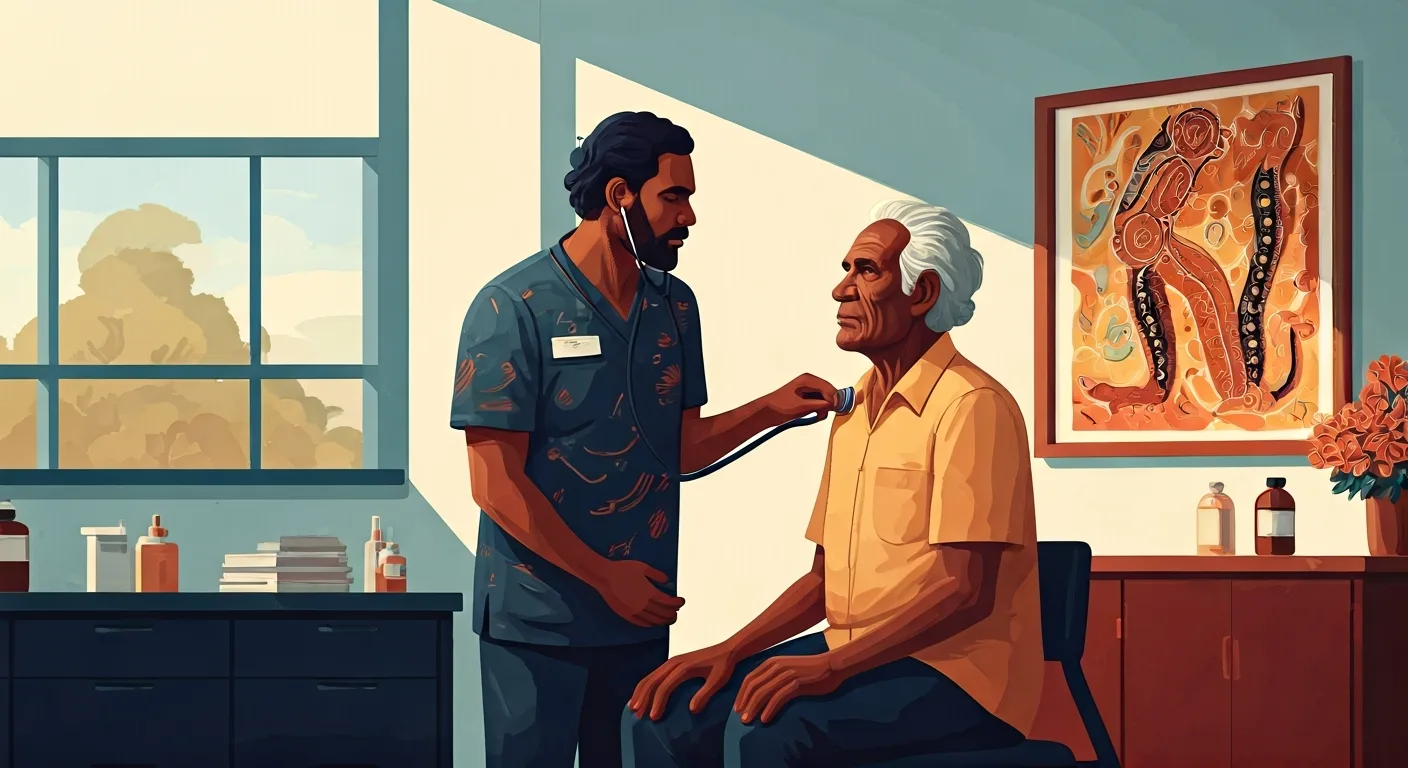
Delivers primary health care assessments and treatments within Aboriginal and Torres Strait Islander communities, coordinating with doctors and specialists to manage chronic conditions and promote preventive care. This role involves culturally appropriate health education, advocacy, and support, working to improve health outcomes and access to services for Indigenous Australians.
Significantly improves health equity and access to culturally safe healthcare for Aboriginal and Torres Strait Islander communities, leading to better health outcomes and stronger community wellbeing.
On the job
- Conduct health assessments, screenings, and deliver primary health care treatments.
- Develop and implement care plans for chronic disease management in collaboration with other health professionals.
- Provide culturally appropriate health education and promotion, focusing on preventive care.
- Advocate for patients to ensure access to necessary health services and support.
- Maintain accurate patient records and contribute to community health programs.
Tools & technology
Average salary
Job outlook
GrowingJob growth is expected to be above average over the next five years.
Education & training
Completion of a Diploma or Advanced Diploma in Aboriginal and/or Torres Strait Islander Primary Health Care, or equivalent qualification, is typically required.
AI impact outlook
Note — this is our current view. AI is moving fast, so we revisit these ratings.
Show how this was assessed Hide the detail
Note — this is our current view. AI is moving fast, so we revisit these ratings.
Show how this was assessed Hide the detailWhy this role received this rating
Core task exposure
high
How much of the role’s important work could AI perform?
Health assessments, care plan drafting, and educational material creation are heavily exposed to AI, which excels at synthesizing information and generating text.
End-to-end automation
moderate
Can AI complete the work without substantial human involvement?
While AI can draft many outputs, the coordination with other professionals and the direct advocacy for patients still require human oversight and intervention, preventing full workflow automation.
Adoption pressure
high
How likely are employers to introduce AI into this work?
There is strong incentive for healthcare systems to automate administrative and documentation tasks to free up clinical time, especially in under-resourced areas.
Human dependence
strong
How much does success depend on human judgement, relationships and accountability?
Success critically depends on culturally appropriate communication, trust-building within communities, and nuanced advocacy, all requiring deep human judgment and relationships.
Protective — a higher rating lowers the overall score.
Role adaptability
strong
How easily can the role evolve as AI takes on more tasks?
The role can adapt by shifting focus from documentation and routine screenings to more complex case management, advocacy, and direct patient support, leveraging AI as a tool.
Shown for context — not part of the score.
What AI may take on
These are the parts of the role most likely to be automated or significantly accelerated.
- Drafting initial care plans for chronic disease management
- Generating culturally appropriate health education content
- Summarizing patient records and health histories
- Automating routine health screening reminders and follow-ups
- Synthesizing data for community health reports
Where people remain essential
These parts continue to depend heavily on human judgement, relationships and accountability.
- Conducting sensitive face-to-face health assessments
- Building and maintaining trust within Indigenous communities
- Advocating for patients to navigate complex health systems
- Providing culturally specific emotional and social support
- Coordinating care across diverse healthcare professionals
- Responding to emergent patient needs
How the role may evolve
From documentation burden to empowered advocacy.
AI tools will handle much of the information synthesis and drafting, enabling practitioners to spend more time on direct patient interaction, advocacy, and addressing the unique social and cultural determinants of health.
Strengthen your future fit
- Mastering prompt engineering for AI-assisted documentation and content generation
- Enhancing active listening and empathetic communication
- Developing advanced skills in patient advocacy and navigation
- Strengthening cultural competency and community engagement
- Specializing in complex case management and care coordination
- Assessment horizon
- 3–7 years
- Confidence
- High
- Last reviewed
- August 2026
- Methodology
- v1.0
This assessment reflects current AI capabilities and expected adoption patterns. Actual impacts will vary by industry, employer and the way each role is performed.
Career pathways
WHERE YOU COULD GO
CURRENT ROLE
Indigenous Health Practitioner
Medical & Clinical
ADJACENT MOVES
STARTING POINTS
Who thrives here
Interest profile
social · SIR
Individuals who are highly social, enjoy helping others, and are inclined towards investigative and realistic problem-solving in a community health context often thrive in this role.
Personality characteristics
Caring and Empathetic
Connects genuinely with individuals and communities, understanding and responding to their health needs with compassion.
Organised and Thorough
Manages complex patient cases, appointments, and documentation with precision and attention to detail.
Community-Minded
Driven by a desire to serve and improve the wellbeing of specific community groups.
Practical Problem-Solver
Applies practical knowledge and skills to address immediate health concerns and implement effective care strategies.
Calm Under Pressure
Maintains composure and effectiveness when responding to urgent health situations or challenging patient circumstances.
Best for
- Individuals passionate about improving health outcomes for Aboriginal and Torres Strait Islander communities.
- Healthcare professionals who thrive in direct patient interaction and community-based settings.
- Those who value culturally informed practice and advocacy.
Watch out for
- The role can involve emotionally challenging situations and exposure to health disparities.
- Requires adaptability to diverse community needs and sometimes unpredictable work environments.
A week in the life
A representative working week for an Indigenous Health Practitioner — where the deep work, meetings, and admin actually land.
Real people. Real results.
Thousands of people
can't be wrong.




Frequently asked questions about Indigenous Health Practitioner roles
What does an Indigenous Health Practitioner do?
An Indigenous Health Practitioner delivers primary health care assessments and treatments within Aboriginal and Torres Strait Islander communities, coordinating with doctors and specialists to manage chronic conditions and promote preventive care. This role involves culturally appropriate health education, advocacy, and support, working to improve health outcomes and access to services for Indigenous Australians. Significantly improves health equity and access to culturally safe healthcare for Aboriginal and Torres Strait Islander communities, leading to better health outcomes and stronger community wellbeing.
How much does an Indigenous Health Practitioner earn?
An Indigenous Health Practitioner earns a median of AUD 75,000 per year, typically ranging from AUD 50,000 to AUD 95,000.
What qualifications do you need to become an Indigenous Health Practitioner?
To become an Indigenous Health Practitioner, completion of a Diploma or Advanced Diploma in Aboriginal and/or Torres Strait Islander Primary Health Care, or equivalent qualification, is typically required. Registration with the Aboriginal and Torres Strait Islander Health Practice Board of Australia (AHPRA) or equivalent national health practitioner registration.
What personality suits an Indigenous Health Practitioner?
Indigenous Health Practitioner roles tend to suit people who are highly conscientious — precise, organised and strong on follow-through (Conscientiousness 78/100) and warm and cooperative — tuned in to the people around them (Agreeableness 75/100). The traits that matter most in the role are Caring and Empathetic, Organised and Thorough, Community-Minded and Practical Problem-Solver. Connects genuinely with individuals and communities, understanding and responding to their health needs with compassion. On interests, Indigenous Health Practitioner maps to a SIR Holland Code profile — individuals who are highly social, enjoy helping others, and are inclined towards investigative and realistic problem-solving in a community health context often thrive in this role.
Who does an Indigenous Health Practitioner role suit?
An Indigenous Health Practitioner role is usually a strong fit for these reasons. Strong Social alignment: the role is centered on helping and caring for community members. High Conscientiousness is rewarded for managing complex health plans and patient records. The role offers opportunities for investigative work, diagnosing needs and developing solutions.
What are the downsides of being an Indigenous Health Practitioner?
Indigenous Health Practitioner roles come with trade-offs worth weighing up. The role can involve emotionally challenging situations and exposure to health disparities. Requires adaptability to diverse community needs and sometimes unpredictable work environments.
What is the work environment like for an Indigenous Health Practitioner?
Work as an Indigenous Health Practitioner is mostly field-based with onsite arrangements common, semi-structured — a mix of set processes and self-directed work, a moderate pace and high exposure to clients or stakeholders. Around 60% of the week is focused deep work.
What skills do you need to be an Indigenous Health Practitioner?
Core skills for an Indigenous Health Practitioner include Culturally safe practice, Primary health care delivery, Chronic disease management, Health education and promotion, Community engagement and Patient advocacy.
How do you become an Indigenous Health Practitioner?
Common entry routes into Indigenous Health Practitioner roles include Indigenous Health Worker and Community Health Assistant.
What career progression is there for an Indigenous Health Practitioner?
From an Indigenous Health Practitioner role, common next steps include Senior Indigenous Health Practitioner and Team Leader, Indigenous Health Services; lateral moves include Community Health Program Coordinator.
What is the job outlook for Indigenous Health Practitioner roles?
The outlook for Indigenous Health Practitioner roles is currently rated growing. Job growth is expected to be above average over the next five years.
Will AI replace Indigenous Health Practitioner roles?
Traitstack rates automation risk for Indigenous Health Practitioner roles at 56 out of 100, which is moderate. AI could significantly streamline health assessments, care plan drafting, and educational material, allowing practitioners to deepen focus on advocacy and culturally appropriate patient relationships. AI is most likely to take on drafting initial care plans for chronic disease management, generating culturally appropriate health education content and summarizing patient records and health histories. Conducting sensitive face-to-face health assessments, building and maintaining trust within indigenous communities and advocating for patients to navigate complex health systems stay with people. From documentation burden to empowered advocacy. That score measures how much of the work could change, not the likelihood the job disappears. It is Traitstack's current view, revisited as AI capability moves.