Arborist
SOC 37-3013.00 · ESCO 6113 · OSCA 342231
Role snapshot
Overview
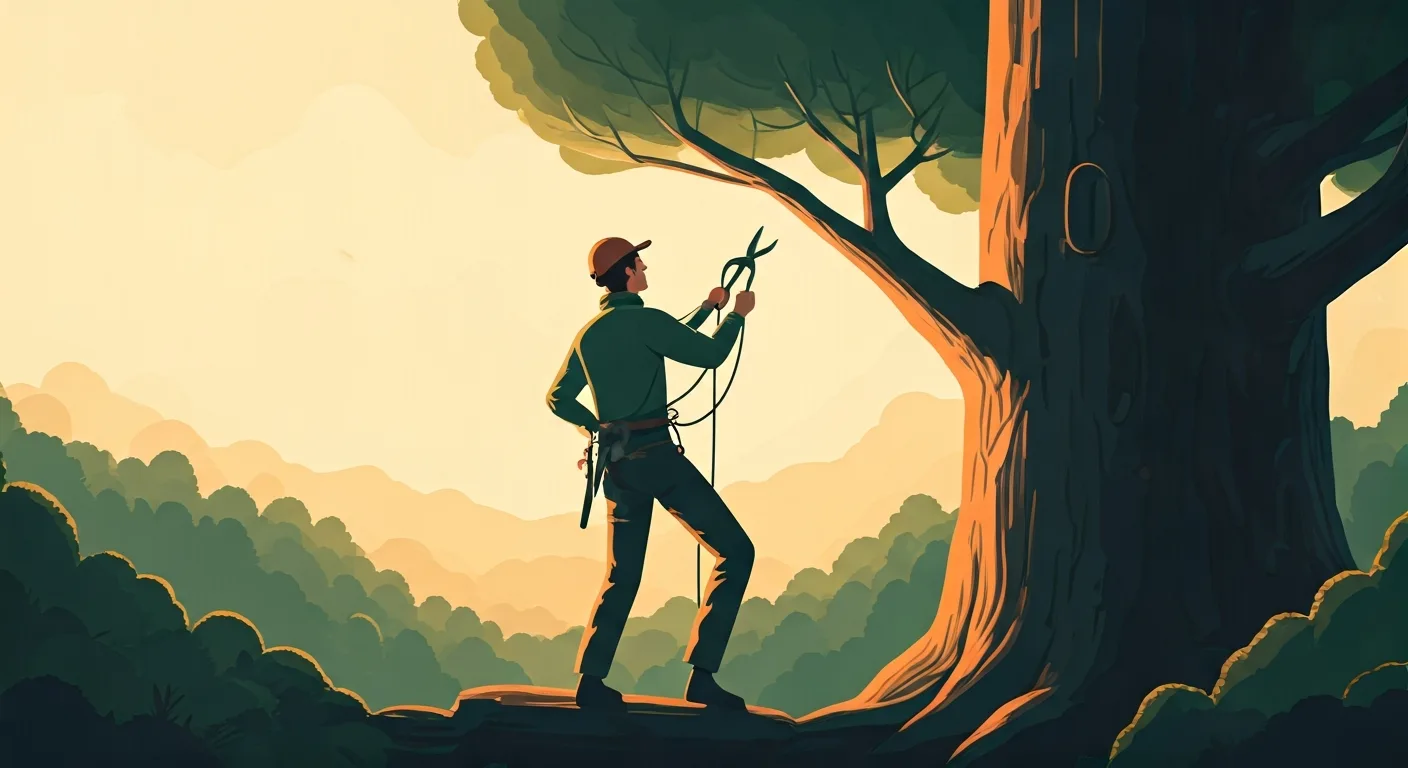
Assesses, prunes, and removes trees using climbing techniques, chainsaws, and aerial platforms. Diagnoses tree diseases, advises property owners on tree health, and ensures work is done safely near power lines and buildings. Arborists are responsible for the health, safety, and aesthetics of trees in urban and natural environments, performing tasks from planting and maintenance to emergency removal.
Contributes to public safety by managing hazardous trees, enhances urban green spaces, and promotes ecological health through proper tree care and disease management, thereby improving community well-being and environmental sustainability.
On the job
- Inspect trees to diagnose diseases, pest infestations, and structural weaknesses
- Perform tree pruning, trimming, and removal using specialized equipment and climbing techniques
- Operate chainsaws, chippers, stump grinders, and aerial lifts safely and efficiently
- Advise clients on tree health, appropriate planting, and long-term care plans
- Respond to emergency calls for storm-damaged or hazardous tree removal
Tools & technology
Average salary
Job outlook
StableDemand is steady. This is an established role with consistent hiring across sectors.
Education & training
Certification from a recognized arborist program or an associate's/bachelor's degree in arboriculture, forestry, or horticulture is often preferred.
AI impact outlook
Note — this is our current view. AI is moving fast, so we revisit these ratings.
Show how this was assessed Hide the detail
Note — this is our current view. AI is moving fast, so we revisit these ratings.
Show how this was assessed Hide the detailWhy this role received this rating
Core task exposure
low
How much of the role’s important work could AI perform?
Initial tree health diagnostics and optimal pruning planning could see AI assistance, but physical execution is unexposed.
End-to-end automation
low
Can AI complete the work without substantial human involvement?
The highly physical, dangerous, and variable nature of tree care, including climbing and operating heavy machinery, prevents end-to-end automation.
Adoption pressure
moderate
How likely are employers to introduce AI into this work?
While AI for tree health and risk assessment may be adopted, the high-risk physical execution and custom nature of the work limits automation pressure.
Human dependence
strong
How much does success depend on human judgement, relationships and accountability?
Success depends on expert judgement in hazardous environments, complex biological diagnosis, precise physical skill, and client trust.
Protective — a higher rating lowers the overall score.
Role adaptability
strong
How easily can the role evolve as AI takes on more tasks?
The role can adapt to new tree diseases, evolving safety techniques, and advanced equipment for tree care and removal.
Shown for context — not part of the score.
What AI may take on
These are the parts of the role most likely to be automated or significantly accelerated.
- Identifying tree diseases or pests from image analysis
- Suggesting optimal pruning locations based on tree structure
- Assessing initial risk factors for tree removal
- Managing scheduling and client communication workflows
- Providing data on local tree species and care guidelines
Where people remain essential
These parts continue to depend heavily on human judgement, relationships and accountability.
- Performing high-stakes tree pruning and removal using climbing techniques
- Operating chainsaws and heavy machinery safely in complex environments
- Diagnosing nuanced tree health issues through on-site inspection
- Advising clients on long-term tree care and emergency responses
- Making critical safety decisions near power lines and buildings
- Improvising solutions for unexpected challenges during removal
How the role may evolve
Less initial assessment. More high-stakes climbing and physical intervention.
Arborists will leverage AI for preliminary tree health reports, allowing them to focus intensified expertise on complex, dangerous physical tasks and nuanced client consultations about tree longevity and risk mitigation.
Strengthen your future fit
- Mastering advanced climbing and rigging techniques
- Developing expertise in tree pathology and diagnostics
- Enhancing safety protocols for hazardous operations
- Cultivating strong communication and client advisory skills
- Adapting to new heavy machinery and aerial lift technologies
- Assessment horizon
- 3–7 years
- Confidence
- High
- Last reviewed
- August 2026
- Methodology
- v1.0
This assessment reflects current AI capabilities and expected adoption patterns. Actual impacts will vary by industry, employer and the way each role is performed.
Career pathways
WHERE YOU COULD GO
CURRENT ROLE
Arborist
Skilled Trades
ADJACENT MOVES
STARTING POINTS
Who thrives here
Interest profile
realistic · RCI
People who enjoy physical, hands-on work outdoors, combined with problem-solving and systematic adherence to safety and technical standards, tend to thrive in this role.
Personality characteristics
Conscientious
Highly focused on safety protocols, precise execution, and systematic tree care practices.
Practical
Enjoys hands-on work, operating machinery, and solving tangible problems in the physical world.
Analytical
Applies scientific knowledge to diagnose tree diseases, assess structural integrity, and plan effective treatments.
Cooperative
Works effectively as part of a team, coordinating complex tasks with crew members and communicating with clients.
Calm under pressure
Maintains composure and follows procedures in high-stakes situations like emergency tree removal or working at heights.
Best for
- People who enjoy skilled manual labor, working outdoors, and solving practical problems
- Individuals who are detail-oriented, safety-conscious, and adept at using specialized tools and equipment
- Those who find satisfaction in preserving and enhancing natural environments
Watch out for
- The work can be physically demanding, involving heavy lifting and working in challenging weather conditions
- Requires constant vigilance and strict adherence to safety protocols due to inherent risks (heights, power lines, heavy equipment)
A week in the life
A representative working week for an Arborist — where the deep work, meetings, and admin actually land.
Real people. Real results.
Thousands of people
can't be wrong.
Frequently asked questions about Arborist roles
What does an Arborist do?
An Arborist assesses, prunes, and removes trees using climbing techniques, chainsaws, and aerial platforms. Diagnoses tree diseases, advises property owners on tree health, and ensures work is done safely near power lines and buildings. Arborists are responsible for the health, safety, and aesthetics of trees in urban and natural environments, performing tasks from planting and maintenance to emergency removal. Contributes to public safety by managing hazardous trees, enhances urban green spaces, and promotes ecological health through proper tree care and disease management, thereby improving community well-being and environmental sustainability.
How much does an Arborist earn?
An Arborist earns a median of $55,000 per year in the US, typically ranging from $40,000 to $75,000.
What qualifications do you need to become an Arborist?
To become an Arborist, certification from a recognized arborist program or an associate's/bachelor's degree in arboriculture, forestry, or horticulture is often preferred. ISA Certified Arborist credential.
What personality suits an Arborist?
Arborist roles tend to suit people who are highly conscientious — precise, organised and strong on follow-through (Conscientiousness 78/100) and steady under pressure — deadlines and setbacks do not rattle them easily (Emotional Stability 70/100). The traits that matter most in the role are Conscientious, Practical, Analytical and Cooperative. Highly focused on safety protocols, precise execution, and systematic tree care practices. On interests, Arborist maps to a RCI Holland Code profile — people who enjoy physical, hands-on work outdoors, combined with problem-solving and systematic adherence to safety and technical standards, tend to thrive in this role.
Who does an Arborist role suit?
An Arborist role is usually a strong fit for these reasons. Strong Realistic and Conventional alignment: the role rewards physical skill, outdoor work, and adherence to safety procedures. Involves detailed diagnostic and problem-solving tasks, appealing to Investigative interests. High team interaction and client exposure support collaborative and service-oriented individuals.
What are the downsides of being an Arborist?
Arborist roles come with trade-offs worth weighing up. The work can be physically demanding, involving heavy lifting and working in challenging weather conditions. Requires constant vigilance and strict adherence to safety protocols due to inherent risks (heights, power lines, heavy equipment).
What is the work environment like for an Arborist?
Work as an Arborist is mostly outdoors-based with onsite arrangements common, semi-structured — a mix of set processes and self-directed work, a moderate pace and medium exposure to clients or stakeholders. Around 75% of the week is focused deep work.
What skills do you need to be an Arborist?
Core skills for an Arborist include Tree climbing and rigging, Chainsaw operation and safety, Tree disease diagnosis, Pruning techniques, Aerial lift operation and Client consultation.
How do you become an Arborist?
Common entry routes into Arborist roles include Groundsperson, Tree Worker Apprentice and Landscaping Assistant.
What career progression is there for an Arborist?
From an Arborist role, common next steps include Crew Leader Arborist, Consulting Arborist and Arboriculture Manager; lateral moves include Horticulturist and Forestry Technician.
What is the job outlook for Arborist roles?
The outlook for Arborist roles is currently rated stable. Demand is steady. This is an established role with consistent hiring across sectors.
Will AI replace Arborist roles?
Traitstack rates automation risk for Arborist roles at 27 out of 100, which is low. The critical human judgement in high-risk tree assessment and physical intervention is unlikely to be automated, though AI could aid initial health diagnostics. AI is most likely to take on identifying tree diseases or pests from image analysis, suggesting optimal pruning locations based on tree structure and assessing initial risk factors for tree removal. Performing high-stakes tree pruning and removal using climbing techniques, operating chainsaws and heavy machinery safely in complex environments and diagnosing nuanced tree health issues through on-site inspection stay with people. Less initial assessment. More high-stakes climbing and physical intervention. That score measures how much of the work could change, not the likelihood the job disappears. It is Traitstack's current view, revisited as AI capability moves.