Leaflet or Newspaper Deliverer
SOC 43-5052.00 · ESCO 9621 · OSCA 899934
Role snapshot
Overview
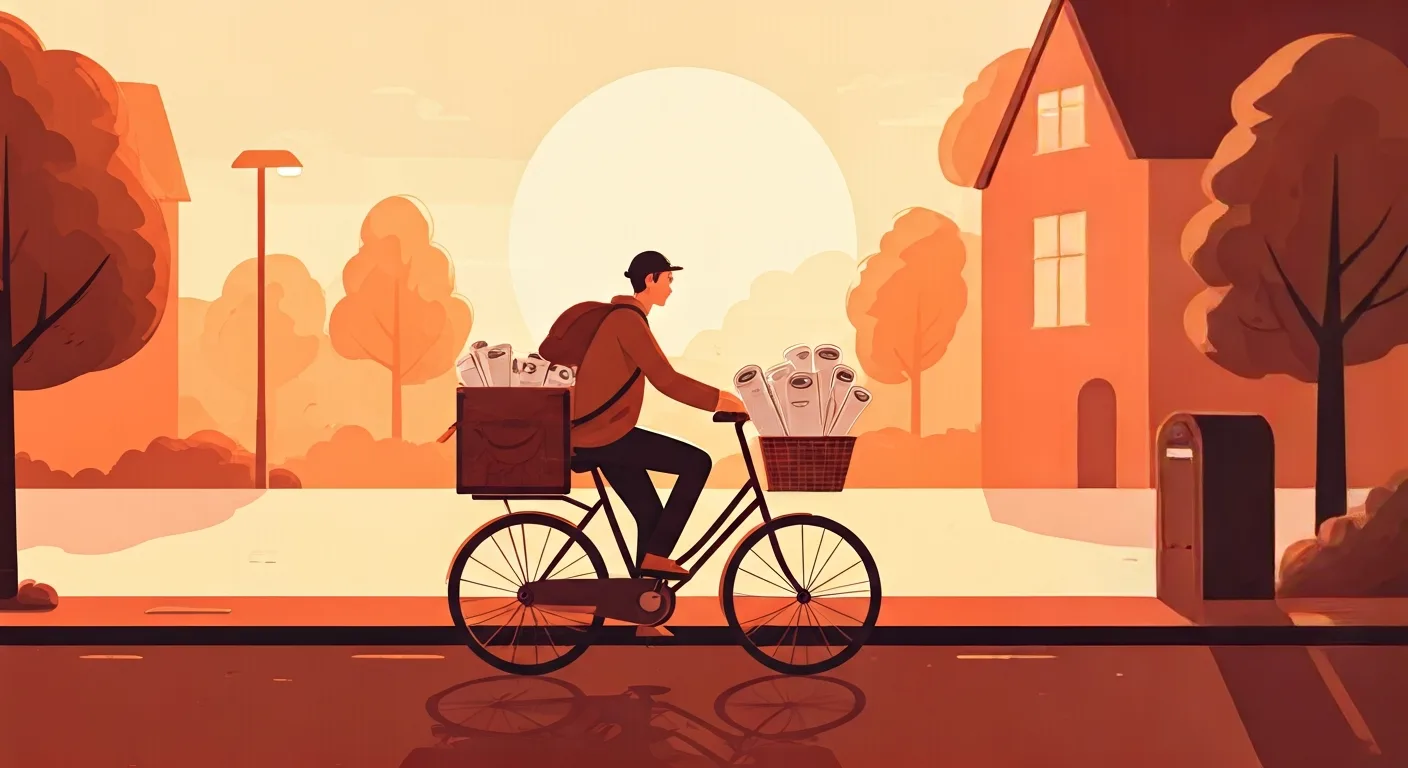
Distributes printed materials such as newspapers, flyers, and catalogues to letterboxes along a set route, typically on foot or by bicycle in the early morning. This role involves collecting and sorting materials, planning efficient routes, and ensuring accurate and timely delivery to designated addresses, often requiring work outdoors in various weather conditions.
Ensures local communities receive timely access to important news, advertisements, and information, supporting local businesses and public awareness.
On the job
- Collect and sort newspapers, leaflets, and other printed materials at a distribution point.
- Plan and follow a predetermined delivery route, often on foot or by bicycle.
- Distribute materials accurately to designated letterboxes or delivery points.
- Maintain awareness of safety, especially when working in early morning hours or adverse weather.
- Report any delivery issues or irregularities to a supervisor.
Tools & technology
Average salary
Job outlook
DecliningEmployment in this field is projected to decrease as automation and structural shifts take effect.
Education & training
No formal education is typically required, though basic literacy and navigation skills are beneficial.
AI impact outlook
Note — this is our current view. AI is moving fast, so we revisit these ratings.
Show how this was assessed Hide the detail
Note — this is our current view. AI is moving fast, so we revisit these ratings.
Show how this was assessed Hide the detailWhy this role received this rating
Core task exposure
low
How much of the role’s important work could AI perform?
The core task of physical delivery in diverse, unstructured environments is highly resistant to current AI capabilities.
End-to-end automation
low
Can AI complete the work without substantial human involvement?
Full end-to-end automation is highly improbable due to the complex physical manipulation and navigation challenges.
Adoption pressure
low
How likely are employers to introduce AI into this work?
The high cost of developing and deploying robots for complex, low-value physical delivery makes adoption pressure very low.
Human dependence
strong
How much does success depend on human judgement, relationships and accountability?
Success relies almost entirely on human physical navigation, dexterity, and judgment in an unpredictable outdoor environment.
Protective — a higher rating lowers the overall score.
Role adaptability
low
How easily can the role evolve as AI takes on more tasks?
The role's highly physical and task-specific nature offers limited avenues for strategic reshaping or adaptation.
Shown for context — not part of the score.
What AI may take on
These are the parts of the role most likely to be automated or significantly accelerated.
- Optimizing delivery routes for maximum efficiency.
- Identifying precise delivery points from mapping data.
- Tracking delivery progress via GPS and reporting completion.
- Predicting optimal timing for material collection.
Where people remain essential
These parts continue to depend heavily on human judgement, relationships and accountability.
- Physically collecting and sorting materials.
- Navigating diverse urban and suburban environments on foot or bicycle.
- Accurately placing materials into designated letterboxes.
- Handling unexpected obstacles like closed gates or difficult access.
- Ensuring safety in varying weather conditions and traffic.
- Reporting delivery issues or suspicious activities to supervisors.
How the role may evolve
More precise routes. Still a human on foot.
While AI will make routes more efficient, the fundamental need for human physical presence for final delivery in complex environments will persist, with the role changing little.
Strengthen your future fit
- Mastering efficient route execution and time management.
- Developing strong observational skills for safety and reporting.
- Maintaining physical stamina and outdoor resilience.
- Utilizing digital navigation and communication tools effectively.
- Adapting to changing delivery instructions or conditions.
- Assessment horizon
- 3–7 years
- Confidence
- High
- Last reviewed
- August 2026
- Methodology
- v1.0
This assessment reflects current AI capabilities and expected adoption patterns. Actual impacts will vary by industry, employer and the way each role is performed.
Who thrives here
Interest profile
conventional · CRE
People who thrive in this role often enjoy structured tasks, routine physical activity, and the independence of working alone to complete deliveries efficiently.
Personality characteristics
Conscientious
Reliable and diligent, ensuring all deliveries are made accurately and on time.
Independent
Prefers working alone with minimal supervision, focusing on completing tasks independently.
Orderly
Appreciates clear instructions and following a set routine or route efficiently.
Resilient
Handles challenging weather conditions or unexpected route changes without significant stress.
Practical
Focuses on the immediate, tangible task of delivery rather than abstract or novel approaches.
Best for
- Individuals who prefer independent, routine-driven work.
- Those who enjoy physical activity and working outdoors.
- People looking for part-time work with flexible early morning hours.
Watch out for
- Requires working in all weather conditions, often during early morning hours.
- Limited social interaction and opportunities for creative problem-solving.
A week in the life
A representative working week for a Leaflet or Newspaper Deliverer — where the deep work, meetings, and admin actually land.
Real people. Real results.
Thousands of people
can't be wrong.




Frequently asked questions about Leaflet or Newspaper Deliverer roles
What does a Leaflet or Newspaper Deliverer do?
A Leaflet or Newspaper Deliverer distributes printed materials such as newspapers, flyers, and catalogues to letterboxes along a set route, typically on foot or by bicycle in the early morning. This role involves collecting and sorting materials, planning efficient routes, and ensuring accurate and timely delivery to designated addresses, often requiring work outdoors in various weather conditions. Ensures local communities receive timely access to important news, advertisements, and information, supporting local businesses and public awareness.
How much does a Leaflet or Newspaper Deliverer earn?
A Leaflet or Newspaper Deliverer earns a median of $20,000 per year in the US, typically ranging from $15,000 to $25,000.
What qualifications do you need to become a Leaflet or Newspaper Deliverer?
To become a Leaflet or Newspaper Deliverer, no formal education is typically required, though basic literacy and navigation skills are beneficial.
What personality suits a Leaflet or Newspaper Deliverer?
Leaflet or Newspaper Deliverer roles tend to suit people who are practical and grounded — happier with proven methods than experimentation (Openness 28/100) and steady under pressure — deadlines and setbacks do not rattle them easily (Emotional Stability 72/100). The traits that matter most in the role are Conscientious, Independent, Orderly and Resilient. Reliable and diligent, ensuring all deliveries are made accurately and on time. On interests, Leaflet or Newspaper Deliverer maps to a CRE Holland Code profile — people who thrive in this role often enjoy structured tasks, routine physical activity, and the independence of working alone to complete deliveries efficiently.
Who does a Leaflet or Newspaper Deliverer role suit?
A Leaflet or Newspaper Deliverer role is usually a strong fit for these reasons. High Realistic and Conventional alignment: the role involves physical activity, working outdoors, and following structured routines. Significant portion of independent, focused work, ideal for those who prefer minimal supervision. Clear, tangible tasks with direct results, offering a sense of completion.
What are the downsides of being a Leaflet or Newspaper Deliverer?
Leaflet or Newspaper Deliverer roles come with trade-offs worth weighing up. Requires working in all weather conditions, often during early morning hours. Limited social interaction and opportunities for creative problem-solving.
What is the work environment like for a Leaflet or Newspaper Deliverer?
Work as a Leaflet or Newspaper Deliverer is mostly outdoors-based with onsite arrangements common, highly structured, with set processes and deadlines, a moderate pace and low exposure to clients or stakeholders.
What skills do you need to be a Leaflet or Newspaper Deliverer?
Core skills for a Leaflet or Newspaper Deliverer include Route planning and navigation, Time management, Physical stamina, Attention to detail and Independent work.
What career progression is there for a Leaflet or Newspaper Deliverer?
From a Leaflet or Newspaper Deliverer role, lateral moves include Parcel Delivery Driver and Postal Worker.
What is the job outlook for Leaflet or Newspaper Deliverer roles?
The outlook for Leaflet or Newspaper Deliverer roles is currently rated declining. Employment in this field is projected to decrease as automation and structural shifts take effect.
Will AI replace Leaflet or Newspaper Deliverer roles?
Traitstack rates automation risk for Leaflet or Newspaper Deliverer roles at 20 out of 100, which is low. Despite AI's potential for route optimization, the core physical delivery of materials in diverse, unstructured environments remains primarily a human task. AI is most likely to take on optimizing delivery routes for maximum efficiency., identifying precise delivery points from mapping data. and tracking delivery progress via gps and reporting completion.. Physically collecting and sorting materials., navigating diverse urban and suburban environments on foot or bicycle. and accurately placing materials into designated letterboxes. stay with people. More precise routes. Still a human on foot. That score measures how much of the work could change, not the likelihood the job disappears. It is Traitstack's current view, revisited as AI capability moves.